We all want to beat the market. The recent volatility in the markets is causing many investors to question if they should sell their favorite companies and wait for a better day. Others are just resigned to ride it out, believing in the buy and hold approach. After all, that is what they have been told by their brokers, or read in various publications and books. Is there a way to hold on to the best companies and just buy some down side insurance to protect against potential losses. It turns out you can have cake and eat it too. Buying put options that protect against a stocks decline offers just this type of insurance.
Before we learn to invest using protective put options, let us review some of the basics. If you feel you understand the basics feel free to move on to the Protective Put Strategies section.
A put option gives the owner of the put the right, but not the obligation to sell 100 shares of the underlying asset, in this case stock, at a specific price known as the strike price until a specified expiration date. No matter how low the stock price falls, you still can sell it for the strike price until it expires. American options can be exercised at any time up to and including the expiration date. European options are only exercised on the expiration date.
For example, an XYZ April 50 put gives the owner the right to sell 100 shares of XYZ stock at $50 per share up to the expiration date of the third Friday in April, even if the share price falls to $25 per share. Nice insurance, which is why these put options are often called a protective put.
What if the price of the stock rises to $75, rather than falls. You get to keep all the gains in the stock price minus the cost to buy the put option. The put gives you the right but not the obligation to sell shares of the underlying stock at the strike price. However, just like insurance you had to pay a premium to buy the put. If you hold on to the put until it expires, you will loose the entire premium but retain the gain in the stock price. Of course, you could have bought back the put at a lower price, since the shares rose, which would help to lower the premium you paid for the insurance.
The price you pay for a protective put depends on several important factors, including whether strike price is in-the-money, at-the-money or out-of-the-money; the volatility of the underlying stock; and the expiration date to name the most important.
You employ a protective put strategy when you own shares of underlying stock and are concerned about unknown, downside market risks in the near term and you would like some defense. The protective put investor retains all benefits of ownership (dividends, voting rights, etc.) during the life of the put contract, unless you sell your stock. At the same time, the protective put serves to limit downside loss over the life of the put. No matter how much the underlying stock decreases in value during the option's life, the put guarantees you the right to sell your shares at the put's strike price until the option expires.
If there is a sudden, significant decrease in the market price of the underlying stock, you have the luxury of time to react. Whereas a previously entered stop loss limit order on the purchased shares might be triggered at both a time and a price unacceptable to you, especially if the price of the shares then rebounds back up. The put contract has conveyed to you a guaranteed selling price at the strike price and control over when you choose to sell your stock.
The table below briefly describes the key factors that are important to understand regarding protective puts:
Factor |
Description |
| Maximum Profit | Current Stock Price – (Stock Purchase Price + Premium Paid) |
| Maximum Loss | Strike Price – (Stock Purchase Price + Premium Paid) |
| Upside Profit at Expiration | Gains in the underlying stock value since purchase – Premium Paid |
| Break-Even-Point | Stock Purchase Price + Premium Paid |
| Volatility |
If Volatility Increases: Positive Effect If Volatility Decreases: Negative Effect |
| Time Decay | As time passes the value of the put will decline |
You should buy protective puts when you are bullish on a stock but are concerned that something might go wrong. Maybe there is an upcoming earnings report or the Federal Reserve is scheduled to make a rate change announcement. Protective puts allow you to stay in the market with limited down side risk when your perception of risk is high. However, what you are really insuring yourself against when you buy a protective put is making the wrong investment decision. What if you sold your stock, triggered by a stop loss that closed out your position on a dip in the price, and then the price rebounds back up and keeps climbing. In this case had you used a normal stop you would have missed out on the longer term gain. Using a protective put in this case kept you from selling your stock inadvertently. If the price of your stock keeps climbing you should sell your protective put for a loss (less the gain in the share price) and then wait for a time to buy another protective put at appropriate time.
On the other hand, what if the price of your stock keeps falling to new lows without rebounding. This would cause you great worry and loss of capital. If you had used a protective put to reduce the risk of these wrong decisions, you can be right either way, (either the stock went up and you did not sell it, or the stock went down and you covered your losses with the put).
You can adjust your put hedge to suit your expectations and your perception of risk, as described in the examples below.
One of the decisions an investor needs to make is what strike price they should use when buying a protective put. The strike price is the price you will receive if you decide to exercise your put option. The higher the strike price the more premium you must pay to buy the put option.
Your choice of which strike price to select depends on your expectations for the price of the underlying shares. If you are bullish on the stock and expect it to rise, you might want to select a strike price that is above the current share price. On the other hand, if you bearish on the stock price over the near term, then you might want to select an in-the-money or at-the-money strike price.
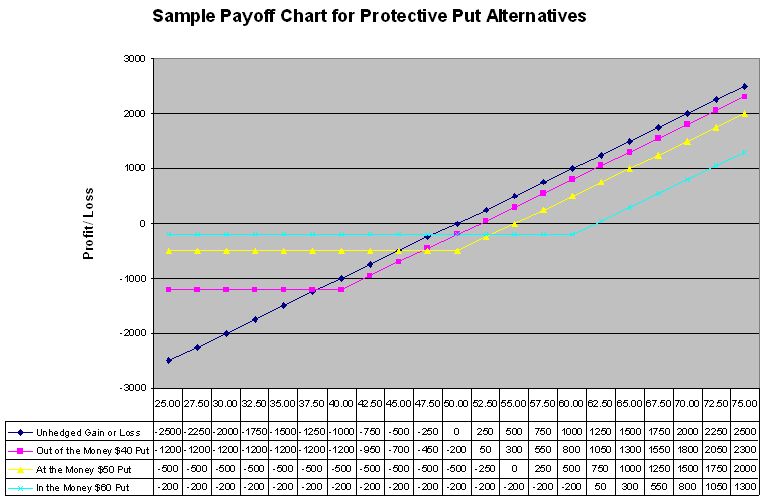
The chart below shows the outcome for the different outcomes depending on the strike price you have selected, showing an unhedged stock position, and hedged positions for in-the-money, at-the-money and out-of-the-money puts. The chart assumes the current share price is $50. The out-of-the money strike price is $60 and it is selling for $12. The at-the-money strike price is $50 and sells for $5. The in-the-money strike price is $40 selling at $3.
Your choice of which strike price depends on your outlook for the stock over the near term.
Bullish Outlook
If you have a bullish outlook for your stock price over the next few weeks to months, but are concerned that market and/or news events could cause the price of your stock to fall, then you should consider selling out-of-the money put options. This strategy allows you to take advantage the appreciation in the underlying shares as the only cost to you is the premium paid for the option and the transaction costs.
The negative to using out-of-the money put options to hedge your position is your down side risk is greater.
In the above chart the out-of-the-money put strike price is $40 and sells for $3.00. Your down side protection starts at $40. Should the price of your stock fall below $40, then your put option gives you the right to sell your stock at $40 until it expires. In the above example this limits your loss to a maximum of $1,300 ($1,000 difference in strike price and the current price of the stock plus the premium paid for the put option of $300). This applies no matter how low the price of your stock falls.
Neutral Outlook
Bearish Outlook
Strategy Summary
For example, the price of XYZ is at $45.00 per share, with the at-the-money $45 strike offered at (i.e. asking price) $4.60, the in-the-money $55 offered at $11.35 and the out-of-the-money $35 put trading at $1.25. The term at-the-money means the stock is trading at the same price as the strike price. For in-the-money put the stock is trading below the strike price of the put. Out-of-the-money puts strike price is below the trading price of the underlying stock.
The chart below along with its data table shows the different outcomes from 100 shares un-hedged, 100 shares hedged with the at-the-money put, an out-of-the-money put and an in-the-money put. The Profit is determined by the Current stock price minus the premium paid for the protective put. The loss is calculated by the Strike Price - (Stock Purchase Price + Premium Paid). Notice that with the in-the-money put, you suffer the least loss if the stock drops sharply, but you also have the lowest gain if the stock rises.
Which of these put options offers the maximum insurance? The in-the-money put since it protects the downside more than the other puts. However, you will have the least gains if the price of the stock rises, After all, if you just wanted to protect against a loss, your best choice would be to sell the stock and hold cash. But then, you would have given up the chance for any further gains in the stock.
Buying the at-the-money $45 strike put at $4.60 may offer a better choice. If you are uncertain about the direction of the stock, and do not want to be wrong if the stock makes a big move in either direction, then the at-the-money strike put is the insurance you want to buy.
With the at-the-money put, if the stock rises to $65, you will have participated in all of the $1,000 gain in a 100-share stock position, but will be out the $460 paid to purchase the put. Alternatively, if the stock declines $10 to $35, all you will lose is the $460 premium, since coverage of the put will kick in as soon as the stock goes below $45. Many investors use this simple rule of thumb: if you expect a lot of volatility, but are uncertain about the direction, then buy the at-the-money put.
Suppose you were more bullish than bearish on the stock, but wanted to cover yourself should the stock unexpectedly decline sharply. In this case, you may want to cover your exposure by buying insurance in the form of the out-of-the-money put. Looking again at chart above, notice that if you buy the out-of-the-money $35 strike put at $2.45 ($245 for one option), your protection at expiration starts at this lower strike price. However, if the stock rises instead of declines, your gains will be better than if you hedged by buying the at-the-money put.
When you hedge with an out-of-the-money put, you are essentially buying deductible insurance. The most you can lose on 100 shares covered with the $35 put in this example is $1,245, i.e. your $1,000 "deductible" (represented by the distance between the common and the strike prices) and the $245 you paid for the put. Even if the stock were to go to $25, the most you can lose on this position is $1,245.
Buying the in-the-money put is also another form of deductible insurance, even though most people don't see it that way. Remember that with the $55 strike put, $10 of the premium is actually tangible value and only $1.35 is time premium.
As your put option approaches expiration, you need to take action depending on the value of the option at expiration. If the put option expires with no value, you do not need to take any action and you may retain our shares. If the option closes in-the-money, you can elect to exercise your right to sell the underlying shares at the put's strike price. Alternatively, you may sell the put option, if it has market value, before the market closes on the option's last trading day. The premium received from the long option's sale will offset any financial loss from a decline in underlying share value.
As the stock moves higher, you might want to roll the put up and or forward by selling the contracts you own and buying another one at a higher strike price or new expiration date. This way, you can lock in profit from the move higher. Too many investors have learned the hard way that what goes up rapidly can drop with equal momentum.
Buying an at-the-money put or one of several out-of-the-money contracts has different advantages and risks. For most underlying stocks, there will be a listed put contract with a strike price and expiration month that optimally fits the balance of risk vs. reward. Keep in mind that protective puts do expire, sometimes before they provide any insurance value. In this case you might choose to roll a shorter-term protective put position by selling an existing put position and purchasing another with a different expiration month and possibly a different strike price. As an alternative, you might consider LEAPS® put contracts, which can have a lifespan of up to three years.
Some investors sell covered call options to help pay for the premium required to buy a protective put option. When you sell a covered call you receive cash in return for the obligation to sell the the stick at the strike price of the covered call. The risk you face is you might have to sell your stock should the call be exercised. There are additional covered call strategies described in a series of four articles that provide investors some down side protection as well as income.
If you want to learn more about using options consider reading Options Made Easy: Your Guide to Profitable Trading (2nd Edition) by Guy Cohen. It is a good way to help you to get started learning about options.
With the market volatility we are now experiencing, stop losses are causing many investors to close out positions in companies that they would prefer to hold, if they had another way to reduce the down side risk. Buying protective puts gives you the comfort level you need to hold individual securities. This strategy may be viewed as more conservative than a simple stock purchase since as long as a put is held against an underlying stock position there is limited downside risk. This strategy provides a guaranteed selling price, its primary benefit. You know at what price the shares can be sold no matter how low the stock's price drops. On the other hand, the protective put does not place a cap on how high the stock may be sold. As a result you enjoy unlimited upside profit potential as the price of the underlying stock continues to increase. As long as the investor owns the shares he continues to receive any dividends paid to shareholders.
As with any long option position, you must pay a premium for the protective put and its many benefits. This increases the break-even point for the underlying shares that youown equal to the combined cost of the stock and the put. If at any point while owning the put the investor decides that further protection on the shares is not needed, the put may be sold if it has market value. If the price of the underlying shares has fallen, you may be able to book a profit on your put trade.
Protective puts offer important advantages over just using stop loss orders. It will pay you to learn how to use them, especially in these volatile markets.